
Working Together for Change: Three Years of EDAC and SWAN Co-production, Research and Clinical Partnership. Improving understanding, support and treatment for autistic people with eating disorders through lived experience, research and clinical collaboration.
Last week BEAT published its new report, Not Designed For Me: Transforming Eating Disorder Support for Autistic People.
At SWAN, we were delighted to see this important exploration of experiences that autistic people, and SWAN, have been highlighting and advocating around for many years. The report brings much-needed attention to the ways in which eating disorder services are often not designed around autistic people’s needs, experiences or ways of communicating and ways in which we can co-productively work towards changes.
The report draws upon insights and learning from EDAC the Eating Disorders and Autism Collaborative. We wanted to take this opportunity to share an update on EDAC’s work over the past three years and SWAN’s involvement in it, both as an organisation and through the contributions of individuals from the SWAN community.
Who are EDAC?
EDAC is a research network funded by the Medical Research Council, Medical Research Foundation and National Institute of Health Research. It is designed to bridge the gap between autism and eating disorder research. Central to EDAC’s ethos is the concept of being Autistic-led, and we aim to work with members of the Autistic community at every stage of our projects to conduct autism-affirming research.
"We would like to say a huge thank you to SWAN and all of the SWAN community for embracing EDAC and being willing to work with us for the past three years. We are hoping that the co-produced a research we have done is meaningful and will have clinical impact.
We have summarised some of the work we have done together below – there has been lots! so thank you so much for all of your hard work!"
Dr Fiona Duffy and Dr Karri Gillespie-Smith on behalf of the EDAC team

The Team at EDAC have shared a summary report of the work we have done together over the last three years, thank you to everyone at SWAN who has been involved at all the various stages
Work Stream 1 – Coming Together: Ethics & Collaborative Working
When we started EDAC we wanted to make sure we got things right. We started by understanding how to co-produce research in this area (rather than researchers just deciding) and worked with Autistic people with lived experience of an eating disorder to help us with this. SWAN facilitated accessible recruitment for five workshops and shared recruitment material on their website and offered peer support to attendees before and after the workshops. The workshops contributed to us understanding the barriers and what helps in co-producing research with Autistic people with an eating disorders, and developing guidelines on how to conduct co-produced research. These publications are freely available and the guidelines, developed so that future researchers can use them, are on our website here: Best Practice Guidelines
- Nimbley, E., Maloney, E., Buchan, K., Sader, M., Gillespie-Smith, K., & Duffy, F. (2024). Barriers and facilitators to ethical co-production with Autistic people with an eating disorder. Journal of Eating Disorders, 12(1), 113.
- Nimbley, E., Maloney, E., Gillespie-Smith, K., Sharpe, H., Buchan, K., … Kettley, S. (2024). Conducting ethical, co-produced research with autistic individuals with an eating disorder: best practice guidelines. Eating Disorders, 1–11.
Workstream 2 – Setting the Agenda
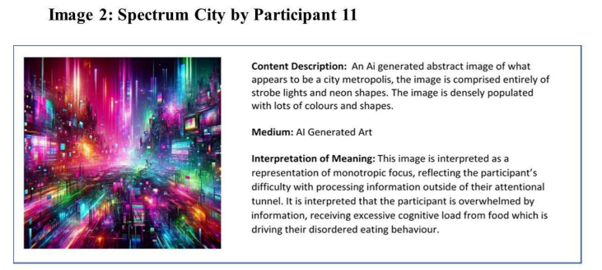
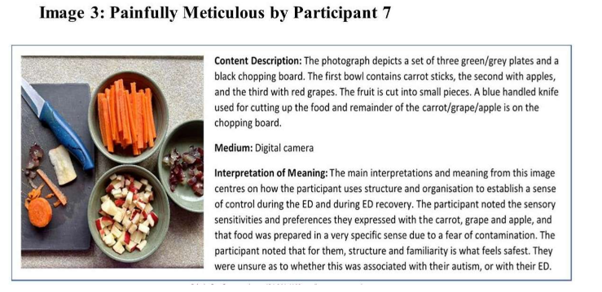
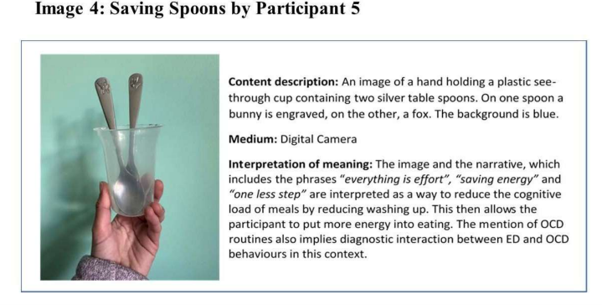
After understanding how we needed to do research we were then interested in what we needed to do research on! We used a technique called photovoice, which is where people use pictures to help explain and represent their experiences. SWAN has facilitated recruitment for this study and shared recruitment material on their website, supported participants and we are delighted so many of you took part. We have published two research papers from this. One is on how Autistic people experience an eating disorder and the other is on what we should be researching. Both these papers are freely available here:
- Buchan K, Maloney E, Duffy F, et al. It Is Literally Saving Me Spoons: Autistic People’s Experiences of Eating and Feeding Disorders—A Photovoice Study. Autism in Adulthood. 2026;0(0). doi:10.1177/25739581261482021
- Nimbley, E., Buchan, K., Maloney, E., Kettley, S., Sader, M., Duffy, F., & Gillespie‐Smith, K. (2025). Using Photovoice methods to set research priorities with autistic people with experience of an eating disorder. Journal of Clinical Psychology, 81(8), 677-693.
In addition, outputs from this project have been showcased in art exhibition titled “You’re Not Alone” which we have also hosted online Virtual Exhibition. We are also now extending this study to think about Autistic people with intellectual disabilities and their experiences of feeding and eating disorders. This study has just finished so we are analysing the data now!
And here are some examples of the amazing images that people provided to represent some of their experiences of being Autistic with an eating disorder
Theme | Possible Research Questions | |||||||||
| Impact of Early Experiences |
| |||||||||
| Function of the ED |
| |||||||||
| Barriers and facilitators to ED recovery |
| |||||||||
| Understanding and accommodating for complexity |
| |||||||||
| Changing research culture | How can we effectively use participatory research designs to coproduce evidence-based training in ED services? |
Workstream 3 – Testing the Approach
Next, we wanted to take all this direction about what we should be researching and support some early career researchers to develop their ideas in these areas. We invited researchers to put forward proposals based on the research priorities that had already been set in workstream 2. We then had a panel of Autistic people with lived experience (SWAN helpfully supported the recruitment for this!) review all the applications to think about what studies should be funded. We agreed on four studies, and these are listed below. Some are still in the process of being analysed.
Project 1: Neuroanatomical Differences Associated with Anorexia Nervosa and Masking Behaviour in Autistic Individuals: SWAN has facilitated recruitment for this study and shared recruitment material on their website. Masking was felt to be an area that was incredibly important but under researched so we are excited that we are one of the first MRI studies in this area to explore this more!
Project 2: Supporting Autistic Individuals with Eating disorders, the development of Autistic Peer Support for Autistic Adults or Parents/Carers of Autistic Children/Adolescents with Experience of an Eating Disorder. SWAN has facilitated recruitment for this study and shared recruitment material on their website. This project currently has the following outputs in publication in a peer-reviewed journal and the one on the perspective of parents and carers is in submission.
Sader, M., Llowarch, N., Gerlof, J., Emmerson, F., Maloney, E., Duffy, F., & Gillespie-Smith, K. (2026). “Welcomed as I am, not as I am expected to be”: towards development of peer support for Autistic people with Eating Disorders. Eating Disorders, 1–19.
The study outlines four major themes regarding the purpose, hopes, and potential boundaries of an autism-affirming peer support framework
- Validating Unique Considerations: Peer support provides a space to discuss how autism-specific factors—such as sensory food sensitivities or a high need for predictability—intersect with eating disorder presentations, rather than treating them as purely psychological resistance.
- Building a Positive Autistic Identity: Connecting with peers who share the same neurotype helps individuals reframe their struggles, unmask, and build a healthy sense of identity distinct from their illness.
- “Welcomed as I Am, Not as I Am Expected to Be”: Participants emphasized a profound need for spaces that fully accept neurodivergence, offering safety, authenticity, and relief from the social expectations of conventional healthcare environments.
- Where Peer Support May Harm Rather Than Help: The community also flagged boundaries, noting that peer spaces must be structured carefully to prevent the accidental triggering of eating disorder behaviors or the echo-chambering of restrictive habits.
Project 3 – Dr Phaedra Longhurst - AuDHD people’s experiences, understanding, and perceptions of intuitive eating: A qualitative photovoice study.
Project 4 – Dr Hannah Lewis – Exploring how to make The Body Portc autism-affirming
Workstream 4 – Knowledge Mobilisation: Policy & Clinical Partnerships
Finally after all of this research we have been focusing on how to integrate it into clinical practice with regular meetings around elements of practice to explore accessibility and adaptability. Many thanks to Becky Choat, Delivery and Development Manager at SWAN who has been working with local services to think about how to make treatment and care more autism affirming. This has led to several different workshops, publications and resources over the past three years. The following is a snapshot of some of this activity.
- Adapting FT-ED for Autistic young people and their families.
Eating disorder focused family therapy is the first line intervention for young people presenting with Anorexia Nervosa. However, eating disorder services delivering FT-ED report that Autistic young people and those with higher autistic traits have an increased likelihood of needing more intensive care and longer treatment duration (Bentz et al., 2022, 2025; Stewart et al., 2017). EDAC’s work exploring clinician (Duffy et al., 2025, Nimbley & Austin et al., 2026), young people (Haugaard et al., 2025) and parents/carers (Nimbley et al., 2026) experience of delivering or receiving this intervention identified specific themes that would lend themselves to making adaptions to the model. Thanks to funding from the Medical Research Foundation we were able to translate this research into co-produced guidelines on how to adapt FT-ED for Autistic young people and their families. The guidelines are now published (Duffy et al., 2026) and training for clinicians is freely available via EDACs website. . We are now working on resources that can go alongside these guidelines.
Reference: Duffy F, Baldoza SM, Baudinet J, Birch I, Broadhurst E, Dimitropoulos G, Ellison C, Gillespie-Smith K, Loomes R, Malik U, Maloney E, Small L, Tchanturia K, Thomas Yates I, Nash F, Austin A. Adapting eating disorder focused family therapy for Autistic children and young people with anorexia nervosa: evidence informed, co-produced clinical guidelines. Eat Disord. 2026 Jul 29:1-17. doi: 10.1080/10640266.2026.2709604.
- Social Stories to support use of nasogastric feeding in inpatient units
Nasogastric tube (NGT) feeding can be used in inpatient care for people with eating disorders, and in certain incidences is necessary under physical restraint. While at times necessary, it is highly distressing. A high proportion of young people who receive NGT feeding under restraint may be Autistic. The Melville adolescent inpatient unit in NHS Lothian CAMHS introduced autism-affirming resources (social stories, individual preference sheet) embedded in a service improvement project to reduce NGT feeding under restraint. A service evaluation found that most young people reported the social stories were helpful or would have been when they first received NGT feeding and most clinicians who had used them stated they had reduced distress. All staff and young people who had used the preference sheet to support collaborative care planning found it helpful. These findings were embedded in a larger QI project which saw a reduction in NGT feeding under restraint from a median of 20 to 1.5 a week over one year. The evaluation has been written up, alongside all of the NG stories for other services to use, and are freely available.
Duffy F, Freak R, Peebles I, Cockburn J, Watson K, Manning C, West H and Austin A (2026) “It gave me a sense of control in a treatment where I felt I had none”: the use of social stories and preferences to reduce the use of restraint during nasogastric tube feeding in young people with anorexia nervosa. Front. Psychiatry 17:1900582. doi: 10.3389/fpsyt.2026.1900582
- Use of a sensory checklist to audit our clinical environments
At EDAC we co-produced a sensory checklist which can be used as part of a walk around audit of the clinical environment (clinic rooms, waiting rooms, physical health treatment rooms, inpatient units etc) with Autistic people with eating disorders. The aim is to identify sensory experience of these spaces (e.g. bright overhead lighting, food smells) that might be overwhelming for some Autistic patients. This information can then be used to develop an action plan to amend the environment, or where this is not possible to be able to prepare people for this (e.g. providing photos of the environment in advance), to make our clinics as accessible as possible. The audit tool is free to download here: EDAC's Sensory Environment Audit Tool | EDAC
Our initial funding for EDAC has now come to an end, but we do have some ongoing funded projects over the next year and are actively applying for further funding to keep the network going. We would like to extend our extensive gratitude and thanks to SWAN and the SWAN community for their thoughtfulness and generosity while assisting EDAC in generating impactful, lived-experience-led research and look forward to further opportunities together
If you are interested in learning more about autistic people's relationship with food, eating and eating disorders, SWAN continues to offer training in this area. Get in touch with our team info@swanscotland.org